A research-backed guide for parents who want to raise thinkers, not just achievers
🌱 Introduction: The Question That Changes Everything
When a child asks, “Why is the sky blue?”, we often smile, answer quickly, and move on. But that tiny “why” is more powerful than any IQ score ever measured.
It’s not knowledge that defines how far a child will go — it’s the thirst for knowledge.
Modern research agrees: curiosity matters more than IQ and predicts success more accurately than intelligence.
In this article, we’ll explore why curiosity is the true engine of growth, what science says about it, and how you, as a parent, can keep that spark alive.
🌿 What Research Says: The Curious Mind Learns Better
A 2014 study from the University of California found that when people are curious, the brain’s reward system lights up — the same way it does with chocolate or music.
In that state, children’s brains absorb information faster and retain it longer.
Psychologist Todd Kashdan calls curiosity “the engine of achievement” because it fuels learning, resilience, and creativity — the very traits IQ tests can’t measure.
In simple words:
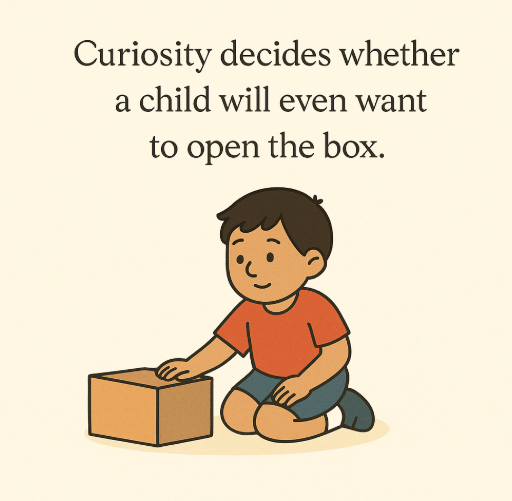
IQ might tell you how efficiently your child can solve a puzzle.
Curiosity decides whether they’ll even want to open the box.
💭 Reflection: How often do we reward right answers, but forget to celebrate the questions?
🌼 IQ Measures the Past. Curiosity Builds the Future.
IQ scores reflect the skills a child already has.
Curiosity reflects the desire to grow beyond them.
Every new invention, discovery, or creative breakthrough in history began with curiosity — not intelligence.
- Einstein called it his “holy curiosity.”
- Marie Curie said, “Nothing in life is to be feared; it is only to be understood.”
- Children show this same raw wonder every day — until the world teaches them to value answers more than questions.
When curiosity fades, learning becomes mechanical.
When curiosity thrives, learning becomes joyful exploration.
🌸 Why Curiosity Outperforms IQ in Real Life
Curiosity teaches children to navigate uncertainty, handle failure, and connect ideas — skills IQ tests don’t capture.
| Skill | IQ Measures | Curiosity Builds |
|---|---|---|
| Memorization | ✅ | – |
| Pattern recognition | ✅ | – |
| Intrinsic motivation | – | ✅ |
| Adaptability | – | ✅ |
| Problem-solving in new situations | ⚠️ | ✅ |
| Emotional connection to learning | – | ✅ |
In today’s world — where jobs, tools, and knowledge change rapidly — it’s not the “smartest” child who thrives.
It’s the one who stays open, adaptive, and eager to learn — no matter what comes next.

🌿 How Curiosity Shapes Emotional Intelligence
Curiosity doesn’t just sharpen the mind — it softens the heart.
Curious children are naturally more empathetic because they want to understand how others feel and think.
When your child asks, “Why is my friend sad?” — that’s emotional curiosity at work.
It leads to compassion, better communication, and stronger relationships later in life.
🌸 Try This:
Next time your child asks a question about emotions, respond with another question:
“What do you think might make your friend feel better?”
You’ll see their empathy bloom.
🌼 School Systems Reward Answers — But Growth Comes from Questions
Traditional education often values correctness over curiosity.
Children quickly learn that knowing is rewarded, while wondering is not.
But research by Harvard’s Project Zero shows that students who are encouraged to ask open-ended questions perform better in creative problem-solving.
So as a parent, your job isn’t to fill your child with facts — it’s to keep their sense of wonder alive, even when schools unintentionally suppress it.
🌸 How You Can Nurture Curiosity at Home
Here are a few simple, everyday ways to protect and grow your child’s natural curiosity:
- Pause before answering.
Let your child think, guess, or imagine before you explain. - Model curiosity.
Let them see you learning something new — reading, exploring, or asking questions. - Create open-ended play.
Fewer structured toys, more imagination. - Ask “what if” questions together.
“What if clouds were made of candy?” — silly questions build creative muscles. - Praise exploration, not only achievement.
“I love how you tried to find out why that happened!” means more than “Good job.”
You can also read this detailed article 7 Research-Backed Ways to Increase Curiosity in Children
🌿 The Parent’s Role: Be a Co-Learner, Not a Teacher
Children mirror our attitudes more than our advice.
If they see us curious — asking questions, trying new things, embracing mistakes — they internalize curiosity as a way of life.
Be a co-learner, not an instructor.
Sit beside them, explore with them, and let curiosity be a shared family language.
💭 Reflection: What’s something you’ve always wanted to learn, but never found time for?
Let your child watch you start today.
🌸 Conclusion: The New Definition of Smart
In a world that changes every year, curiosity is the new intelligence.
IQ may open doors, but curiosity builds the courage to walk through them — and explore what lies beyond.
The goal isn’t to raise the smartest child.
It’s to raise a child who never stops wondering, exploring, and learning.
🌿 Because one curious question can change the world.