Tag: child development

  • The Autonomy Paradox

    The Autonomy Paradox

    There is a particular kind of love that looks like control.

    You see it at the dinner table, when a parent quietly slides the homework closer. You hear it in the car, in the gentle interrogation about the test, the project, the friend who seems to be doing better. You feel it in yourself, late at night, doing the mental math on a future that hasn’t arrived yet — the entrance exam four years out, the competition that is already, somehow, underway.

    None of this comes from a bad place. It comes from the opposite. The more a parent cares about how a child’s life turns out, the more they want to reach in and steer. The caring and the steering feel like the same impulse. That is exactly why this is so hard to see clearly.

    But there is a finding in psychology, now more than fifty years old and tested more thoroughly than almost anything else in the field, that should give every loving, anxious parent pause. The very act of steering — of controlling, monitoring, incentivising, correcting — tends to erode the one thing the steering was meant to protect. It quietly dismantles the child’s own desire to do the thing at all.

    This is the autonomy paradox: the harder a parent pushes a child toward an outcome they’re anxious about, the more they weaken the child’s own internal motivation — the very engine that would have carried the child there on their own. Control, however loving, tends to erode the intrinsic drive it was meant to protect.

    What is autonomy supportive parenting?

    Autonomy supportive parenting means offering structure, belief, and guidance while leaving the child room to feel that their actions are their own. It is the opposite of control — not the absence of involvement, but involvement that protects the child’s sense that the reasons for what they do live inside them.

    A puzzle, a dollar, and a quiet discovery

    In 1971, a young researcher named Edward Deci ran an experiment that seems almost too simple to matter. He gave college students a set of Soma cubes — small three-dimensional puzzles that most people find genuinely absorbing — and asked them to recreate certain shapes over three sessions on different days.

    The clever part was what he measured. In the middle of each session, Deci would leave the room on a pretext. The students were alone, unobserved, with the puzzles in front of them and magazines off to the side. What they chose to do in those free minutes — keep playing, or drift to the magazines — was a clean measure of how much they actually wanted to do the puzzle. Not for a grade. Not for a reward. Just because.

    Here is what he found. One group was paid a dollar for each puzzle they solved on the second day, while the other group was never paid. On that second day, the paid group worked harder — and during their free minutes, they played more. The money was working, apparently.

    But then, on the third day, the payment stopped. And the group that had been paid now spent significantly less of their free time playing with the puzzle than the group that had never been paid at all.

    Read that again. The reward didn’t just stop working when it was removed. It left the students less interested than if they had never been paid in the first place. Something they had genuinely enjoyed had been converted, in a matter of days, into work — into a thing you do for a reason outside yourself. And once the outside reason vanished, so did much of the desire.

    This was not a fluke. Over the following decades the finding was replicated and argued over and replicated again. In 1999, Deci and his colleagues pulled together 128 controlled experiments in a single analysis and reached a clear conclusion: tangible rewards, when expected and tied to doing or completing a task, reliably undermined people’s intrinsic motivation for it.

    It is worth being honest here, because this matters and the science deserves to be reported fairly. Not every researcher agrees on how far this effect reaches; some, looking at the same body of evidence, argue that rewards are less corrosive in the messy real world than in the tidy laboratory. The debate is real. But the core observation — that controlling someone toward a thing they already wanted to do can spoil the wanting — has held up remarkably well. It is one of the most studied counterintuitive truths in all of psychology.

    What the puzzle has to do with your child

    A dollar for a puzzle feels a long way from raising a child. It isn’t.

    Out of this early work, Deci and his collaborator Richard Ryan built what is now called Self-Determination Theory, one of the most influential frameworks in modern psychology. Its central claim is disarmingly simple. Human beings have three basic psychological needs — autonomy, competence, and relatedness — and when those needs are met, motivation and well-being flourish; when they are thwarted, both wither.

    Autonomy is the one that concerns us here. It is the feeling that you are choosing your own behaviour, rather than being controlled or compelled by someone else. It is not the same as independence, and it is certainly not the same as a child doing whatever they like. A child can be given a great deal of structure and still feel autonomous — if the structure leaves room for them to feel that their actions are their own.

    And this is the hinge of the whole thing. What determines whether an outside force helps or harms motivation is not the force itself, but how the child comes to perceive the source of their own behaviour. When a child feels the reason they’re doing something lives inside them — curiosity, interest, a sense that it matters — the motivation is robust and lasting. When they come to feel the reason lives outside them — a parent’s pressure, a reward, the threat of disappointment — the motivation becomes brittle. It works only as long as the external pressure is present. Remove it, and like the dollar for the puzzle, the desire collapses.

    The dollar in the experiment and the anxious parent at the dinner table are doing the same psychological work. Both relocate the reason for the activity from inside the child to outside them. Both are forms of control. And control, however lovingly intended, teaches a child that they are studying, practising, reading, performing — for you. Not for themselves.

    Why anxiety is the engine

    Here is the part that is hard to sit with.

    The control isn’t random. It rises and falls with our fear. The more uncertain a parent feels about a child’s future — the more the rankings and the comparisons and the relentless logic of competition press in — the stronger the urge to manage, to optimise, to take the wheel. Anxiety doesn’t make us neglectful. It makes us controlling. It convinces us that one more push, one more incentive, one more careful intervention is the responsible thing to do.

    I feel this pull most when we play cricket at home. My son plays by his own rules — the way he grips the bat is all wrong, and he’ll hit what should be a boundary, declare himself out, and erupt in delight anyway. Some part of me wants to correct him: the grip, the rules, the scoring. And then I catch it. He is three. He is not playing cricket to get cricket right; he is playing because it is fun, because his body is moving and he is happy. The correction wouldn’t serve his game. It would serve my need to see it done properly. So I let him be.

    And each push does something. In the short term, it often even works — the homework gets done, the marks go up, the visible behaviour improves. This is the trap. The control produces exactly the surface results that reassure an anxious parent, while quietly draining the reservoir underneath. The child performs more and wants less. By the time the cost becomes visible — the teenager who has stopped caring, who does nothing without being pushed, who seems to have misplaced the curiosity they were born with — the connection to its cause is long buried.

    So the paradox completes itself. The parent who cares most about the outcome controls most. The control erodes the child’s own motivation. The eroded motivation produces worse outcomes. And the worse outcomes generate more anxiety, which produces more control. It is a loop that tightens precisely because we love our children and want the best for them.

    What this is not

    It would be easy to read all this as an argument for stepping back entirely — for the kind of hands-off parenting that mistakes neglect for freedom. It is not.

    Self-Determination Theory is emphatic that children need structure, and they need connection — that third need, relatedness, the sense of being securely held by people who care. A child set adrift without guidance is not autonomous; they are abandoned. The opposite of control is not absence. It is support.

    The distinction matters more than almost anything else in parenting, and it is subtle. Controlling support says: do this, because I need you to, because I’m worried, because it’s what gets results. Autonomy supportive parenting says: I’m here, I believe this matters, and I trust you to find your way into it. One treats the child as a project to be managed toward an outcome. The other treats them as a person growing into their own reasons.

    The difference is rarely in what a parent does. It is almost always in why, and in whether the child can feel that why.

    Sitting with the paradox

    My three-year-old loves his magnetic tiles. He builds hotels, a parking area, an office — and the striking thing is that he often ends up with designs none of us could have dreamed up, that he himself hadn’t set out to make. The shape arrives in the building of it. There is no plan he’s executing, no result he’s chasing. There is just the absorption, and the absorption makes the thing.

    Watching him, I notice something I keep forgetting: this is how all of us were once. And it is, quietly, how I do my own best work. The handful of times I’ve been genuinely lost in something — not tracking how it would land, what it would earn, who would notice — are the times I’ve felt most creative and, strangely, most at ease. There is so much here to learn from him. And yet we tell ourselves we are the ones doing the teaching — and somewhere in all that teaching, we take the very thing from them that we ought to be relearning ourselves.

    And so there is no neat technique at the end of this. That would betray the whole idea — the point is not to control your child more skillfully, but to notice when the controlling is being driven by your own fear rather than your child’s actual needs.

    The most useful question a parent can carry is not how do I get my child to do this? It is quieter and more uncomfortable: whose anxiety is this serving? When you feel the pull to slide the homework closer, to add the incentive, to ask about the test for the third time — that pull is real information. Sometimes it points to something the child genuinely needs. Often it points to something you need: relief from the unbearable uncertainty of not being able to guarantee how their life turns out.

    You can’t guarantee it. No amount of control ever could. That is the hard truth underneath the paradox, and also, strangely, the freeing one. The child who is allowed to own their reasons — who studies because it interests them, reads because they fell into a book, tries because failing is survivable — carries an engine that doesn’t switch off when you leave the room.

    That engine was there at the start. Every child is born with it. The deepest work of parenting may not be building it at all. It may be the harder discipline of not putting it out.
  • Why Curiosity Matters More Than IQ in Child Development

    Why Curiosity Matters More Than IQ in Child Development

    A research-backed guide for parents who want to raise thinkers, not just achievers

    🌱 Introduction: The Question That Changes Everything

    When a child asks, “Why is the sky blue?”, we often smile, answer quickly, and move on. But that tiny “why” is more powerful than any IQ score ever measured.

    It’s not knowledge that defines how far a child will go — it’s the thirst for knowledge.

    Modern research agrees: curiosity matters more than IQ and predicts success more accurately than intelligence.

    In this article, we’ll explore why curiosity is the true engine of growth, what science says about it, and how you, as a parent, can keep that spark alive.

    🌿 What Research Says: The Curious Mind Learns Better

    A 2014 study from the University of California found that when people are curious, the brain’s reward system lights up — the same way it does with chocolate or music.

    In that state, children’s brains absorb information faster and retain it longer.

    Psychologist Todd Kashdan calls curiosity “the engine of achievement” because it fuels learning, resilience, and creativity — the very traits IQ tests can’t measure.

    In simple words:
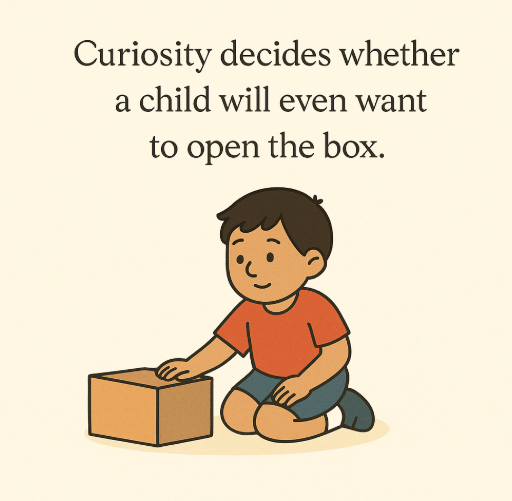
    IQ might tell you how efficiently your child can solve a puzzle.
    Curiosity decides whether they’ll even want to open the box.

    Curiosity Matters More than IQ

    💭 Reflection: How often do we reward right answers, but forget to celebrate the questions?

    🌼 IQ Measures the Past. Curiosity Builds the Future.

    IQ scores reflect the skills a child already has.
    Curiosity reflects the desire to grow beyond them.

    Every new invention, discovery, or creative breakthrough in history began with curiosity — not intelligence.

    • Einstein called it his “holy curiosity.”
    • Marie Curie said, “Nothing in life is to be feared; it is only to be understood.”
    • Children show this same raw wonder every day — until the world teaches them to value answers more than questions.

    When curiosity fades, learning becomes mechanical.
    When curiosity thrives, learning becomes joyful exploration.

    🌸 Why Curiosity Outperforms IQ in Real Life

    Curiosity teaches children to navigate uncertainty, handle failure, and connect ideas — skills IQ tests don’t capture.

    SkillIQ MeasuresCuriosity Builds
    Memorization
    Pattern recognition
    Intrinsic motivation
    Adaptability
    Problem-solving in new situations ⚠️
    Emotional connection to learning

    In today’s world — where jobs, tools, and knowledge change rapidly — it’s not the “smartest” child who thrives.
    It’s the one who stays open, adaptive, and eager to learn — no matter what comes next.

    🌿 How Curiosity Shapes Emotional Intelligence

    Curiosity doesn’t just sharpen the mind — it softens the heart.
    Curious children are naturally more empathetic because they want to understand how others feel and think.

    When your child asks, “Why is my friend sad?” — that’s emotional curiosity at work.
    It leads to compassion, better communication, and stronger relationships later in life.

    🌸 Try This:
    Next time your child asks a question about emotions, respond with another question:
    “What do you think might make your friend feel better?”
    You’ll see their empathy bloom.

    🌼 School Systems Reward Answers — But Growth Comes from Questions

    Traditional education often values correctness over curiosity.
    Children quickly learn that knowing is rewarded, while wondering is not.

    But research by Harvard’s Project Zero shows that students who are encouraged to ask open-ended questions perform better in creative problem-solving.

    So as a parent, your job isn’t to fill your child with facts — it’s to keep their sense of wonder alive, even when schools unintentionally suppress it.

    🌸 How You Can Nurture Curiosity at Home

    Here are a few simple, everyday ways to protect and grow your child’s natural curiosity:

    1. Pause before answering.
      Let your child think, guess, or imagine before you explain.
    2. Model curiosity.
      Let them see you learning something new — reading, exploring, or asking questions.
    3. Create open-ended play.
      Fewer structured toys, more imagination.
    4. Ask “what if” questions together.
      “What if clouds were made of candy?” — silly questions build creative muscles.
    5. Praise exploration, not only achievement.
      “I love how you tried to find out why that happened!” means more than “Good job.”

    You can also read this detailed article 7 Research-Backed Ways to Increase Curiosity in Children

    🌿 The Parent’s Role: Be a Co-Learner, Not a Teacher

    Children mirror our attitudes more than our advice.
    If they see us curious — asking questions, trying new things, embracing mistakes — they internalize curiosity as a way of life.

    Be a co-learner, not an instructor.
    Sit beside them, explore with them, and let curiosity be a shared family language.

    💭 Reflection: What’s something you’ve always wanted to learn, but never found time for?
    Let your child watch you start today.

    🌸 Conclusion: The New Definition of Smart

    In a world that changes every year, curiosity is the new intelligence.
    IQ may open doors, but curiosity builds the courage to walk through them — and explore what lies beyond.

    The goal isn’t to raise the smartest child.
    It’s to raise a child who never stops wondering, exploring, and learning.

    🌿 Because one curious question can change the world.

  • 21 Best Books to Spark Your Child’s Curiosity & Creativity

    21 Best Books to Spark Your Child’s Curiosity & Creativity

    Are you looking for the best books to spark curiosity in kids? Curiosity is the foundation of lifelong learning. Studies show that children who display higher curiosity at a young age perform better academically, especially in reading and math. Research from Harvard also confirms curiosity strengthens memory, attention, and engagement with learning.

    One of the best ways to nurture curiosity is through reading. Books don’t just build literacy—they introduce new worlds, encourage imagination, and inspire children to ask questions.

    Why This Book List?

    With thousands of children’s books available, parents often ask: “Which books will spark my child’s curiosity, not just entertain them?”

    That’s why we’ve curated this list of 21 carefully selected books—grouped into themes like Imagination, STEM, Real-World Explorers, and Big Questions.

    These books were chosen because they:
    ✅ Encourage kids to wonder and ask questions
    ✅ Inspire creativity and problem-solving
    ✅ Introduce science, exploration, or real-world heroes
    ✅ Are fun for both kids and parents to read together

    Books to Spark Curiosity in Kids through Imagination

    1. Not a Box – Antoinette Portis
    A simple cardboard box becomes anything a child imagines—a rocket, a mountain, a race car. This book reminds children that imagination transforms the ordinary into the extraordinary, nurturing creativity and free thinking.

    Buy on Amazon

    2. The Dot – Peter H. Reynolds
    When a teacher encourages Vashti to make her mark, she discovers that creativity begins with just a dot. A powerful story about courage, self-expression, and how small beginnings can grow into big confidence.

    Buy on Amazon

    3. Ish – Peter H. Reynolds
    This tale teaches kids that drawings don’t have to be “perfect” to be valuable—they can be ish. It encourages children to embrace creativity without fear of mistakes, building resilience and joy in self-expression.

    Buy on Amazon

    4. Sky Color – Peter H. Reynolds
    When a girl tasked with painting a sky runs out of blue paint, she learns to see colors in a whole new way. A gentle, inspiring story that teaches children to think beyond limitations.

    Buy on Amazon

    5. Journey – Aaron Becker
    A wordless picture book where a red crayon opens doors to magical worlds. It sparks children’s storytelling abilities, encouraging them to create their own adventures through imagination.

    Buy on Amazon

    6. Quest – Aaron Becker
    The sequel to Journey continues the magical adventure, showing children the power of creativity and teamwork. Beautiful illustrations draw readers into imaginative problem-solving.

    Buy on Amazon

    7. Return – Aaron Becker
    The final book in Becker’s trilogy, blending fantasy and courage. It reminds children of the endless possibilities that curiosity and imagination can unlock.

    Buy on Amazon

    8. What Do You Do With an Idea? – Kobi Yamada
    A heartwarming story about nurturing an idea, even when others don’t understand it. It shows children that ideas grow when protected, valued, and allowed to flourish—sparking confidence in their creativity.

    Buy on Amazon

    Best STEM Books to Spark Curiosity in Kids

    9. Ada Twist, Scientist – Andrea Beaty
    Ada’s endless “Why?” questions lead her to experiment and explore the world scientifically. A perfect story for encouraging curiosity, persistence, and critical thinking in young scientists.

    Buy on Amazon

    10. Iggy Peck, Architect – Andrea Beaty
    Iggy’s love for building is questioned until he proves how architecture can solve problems. Inspires children to value their passions and understand the real-world importance of design and innovation.

    Buy on Amazon

    11. Aaron Slater, Illustrator – Andrea Beaty
    This story celebrates creativity through drawing and storytelling. It encourages children who may struggle with words to find their voice through art, imagination, and perseverance.

    Buy on Amazon

    12. Sofia Valdez, Future Prez – Andrea Beaty
    Sofia shows leadership and determination when she works to transform her community. It empowers kids to see themselves as problem-solvers who can make positive change.

    Buy on Amazon

    13. The Most Magnificent Thing – Ashley Spires
    A young girl sets out to create something amazing but fails repeatedly. Through frustration and persistence, she learns resilience and the creative process, making it a perfect read for budding innovators.

    Buy on Amazon

    14. If…: A Mind-Bending New Way of Looking at Big Ideas and Numbers – David J. Smith
    Explains big concepts like population, distance, and time by scaling them into everyday comparisons. This book makes abstract ideas tangible and sparks mathematical curiosity.

    Buy on Amazon

    15. How Big Is a Million? – Anna Milbourne
    A delightful book that helps children visualize very large numbers through charming illustrations. It turns math into wonder, making numbers feel magical rather than intimidating.

    Buy on Amazon

    Books about Real-World Explorers & Change-Makers

    16. The Watcher: Jane Goodall’s Life with the Chimps – Jeanette Winter
    The inspiring true story of Jane Goodall, whose childhood love for animals led her to groundbreaking discoveries. It shows children how curiosity and patience can change the world.

    Buy on Amazon

    17. The Boy Who Harnessed the Wind (Young Readers Edition) – William Kamkwamba
    The incredible true story of a boy from Malawi who built a windmill from scrap materials to bring electricity to his village. A powerful reminder of how creativity and perseverance can solve real problems.

    Buy on Amazon

    18. Hidden Figures (Young Readers Edition) – Margot Lee Shetterly
    Tells the story of four Black women mathematicians at NASA who helped launch rockets into space. It inspires kids with the importance of determination, diversity, and STEM.

    Buy on Amazon

    19. Women in Science: 50 Fearless Pioneers Who Changed the World – Rachel Ignotofsky
    An illustrated book celebrating women scientists, engineers, and innovators throughout history. It broadens children’s view of what’s possible by showing real-life role models.

    Buy on Amazon

    Books to Spark Curiosity in Kids Who Ask Big Questions

    20. The Big Book of Why – National Geographic Kids
    Answers everyday questions like “Why is the sky blue?” or “Why do animals hibernate?” with fun facts and science. Perfect for fueling the endless curiosity of “Why-asking” kids.

    Buy on Amazon

    21. National Geographic Little Kids First Big Book of Why 2 – National Geographic Kids
    A follow-up with even more engaging explanations—covering topics from the human body to the natural world. It makes learning exciting while encouraging children to keep asking questions.

    Buy on Amazon

    🌟 Final Thoughts & Tips for Parents

    Curiosity isn’t about knowing all the answers—it’s about having the courage to keep exploring. These 21 books are excellent starting points to spark curiosity in children. And if you’d like to nurture your own curiosity as a parent, don’t miss our guide on 5 Books for Parents to Inspire Curiosity in Kids

    Tips for Parents

    • Read the books together with the child
    • After reading, ask open-ended questions like “What do you think?” or “Why might this happen?”
    • Let your child’s questions guide the conversation.
    • Encourage them to create their own stories, drawings, or experiments inspired by these books.
    • Re-read often—each time reveals something new.
  • 5 Books Every Parent Must Read to Nurture a Child’s  Curiosity

    5 Books Every Parent Must Read to Nurture a Child’s Curiosity

    In today’s fast-changing world, education isn’t just about grades and exams — it’s about inspiring children to think deeply, ask questions, and inspire them to love the process of learning. Although we try our best to provide the best education to our children, there are still a lot of gaps in the education system and schools alone cannot provide a holistic development for every child. As a parent, it is our responsibility to create the best learning environment at home as well and we can play a big role in nurturing our child’s curiosity.

    To do this, it is very important for every parents to understand the nuances of child development. There is a lot of research which has been done on this topic and in this post I am sharing five amazing books that offer timeless insights into how children learn, explore, and develop curiosity

    1. The Whole-Brain Child by Daniel J. Siegel & Tina Payne Bryson

    This book is rooted in neuroscience and offers practical strategies to help children integrate both logical and creative thinking. It helps you understand the “how” of brain development so you can create environments that naturally encourage curiosity, problem-solving, and adaptability.

    Why it matters: Knowing how your child’s brain processes information can help you guide their learning experiences more effectively.

    Get it here https://Dr844s.short.gy/urls0k

    2. How Children Learn by John Holt

    A classic in educational philosophy, Holt dives into how children naturally learn — through exploration, play, and observation — long before formal schooling begins. His work reminds us that curiosity is not taught, but nurtured.

    Why it matters: It shifts the focus from “teaching” to “creating the right conditions” for learning to flourish.

    Get it here: https://Dr844s.short.gy/FNCGsh

    3. Mind in the Making by Ellen Galinsky

    This book identifies seven essential life skills — like critical thinking, self-control, and communication — that support lifelong learning. It blends research from neuroscience, psychology, and education to help you cultivate these skills in everyday moments.

    Why it matters: It offers research-backed ways to make everyday interactions richer learning opportunities.

    Get it here: https://Dr844s.short.gy/iWpGBj

    4. Creative Schools by Sir Ken Robinson

    Sir Robinson is one of the top experts in the field of early education and has done exceptional work in creating awareness about how education should be. His Ted talk about whether schools kill creativity is one of the most popular discussions about the education system. In this book, he challenges traditional education systems and shares inspiring examples of how curiosity, creativity, and individualized learning can transform a child’s education. While it focuses on schools, its insights are equally valuable for parents who want to complement school learning at home.

    Why it matters: It’s a wake-up call for rethinking what education means — beyond grades and rigid curricula.

    Get it here: https://Dr844s.short.gy/2jyzLs

    5. Einstein Never Used Flashcards by Kathy Hirsh-Pasek & Roberta Michnick Golinkoff

    Based on years of developmental research, this book debunks the myth that earlier academic drills make smarter kids. Instead, it advocates for play-based learning as the true foundation for intellectual growth.

    Why it matters: In today’s hyper competitive world, where we are worried about whether our child will stay behind, this book gives you the confidence to slow down, avoid over-scheduling, and focus on experiences that spark genuine curiosity.

    Get it here: https://Dr844s.short.gy/JXG9a9

    Final Thoughts

    These books are not about “parenting techniques” — they are about understanding how children learn, how curiosity works, and how you can create an environment that celebrates discovery. Whether you’re choosing activities at home, exploring nature, or discussing big ideas at the dinner table, the right approach can turn everyday life into a classroom without walls.