There is a particular kind of love that looks like control.
You see it at the dinner table, when a parent quietly slides the homework closer. You hear it in the car, in the gentle interrogation about the test, the project, the friend who seems to be doing better. You feel it in yourself, late at night, doing the mental math on a future that hasn’t arrived yet — the entrance exam four years out, the competition that is already, somehow, underway.
None of this comes from a bad place. It comes from the opposite. The more a parent cares about how a child’s life turns out, the more they want to reach in and steer. The caring and the steering feel like the same impulse. That is exactly why this is so hard to see clearly.
But there is a finding in psychology, now more than fifty years old and tested more thoroughly than almost anything else in the field, that should give every loving, anxious parent pause. The very act of steering — of controlling, monitoring, incentivising, correcting — tends to erode the one thing the steering was meant to protect. It quietly dismantles the child’s own desire to do the thing at all.
This is the autonomy paradox: the harder a parent pushes a child toward an outcome they’re anxious about, the more they weaken the child’s own internal motivation — the very engine that would have carried the child there on their own. Control, however loving, tends to erode the intrinsic drive it was meant to protect.
What is autonomy supportive parenting?
Autonomy supportive parenting means offering structure, belief, and guidance while leaving the child room to feel that their actions are their own. It is the opposite of control — not the absence of involvement, but involvement that protects the child’s sense that the reasons for what they do live inside them.
A puzzle, a dollar, and a quiet discovery
In 1971, a young researcher named Edward Deci ran an experiment that seems almost too simple to matter. He gave college students a set of Soma cubes — small three-dimensional puzzles that most people find genuinely absorbing — and asked them to recreate certain shapes over three sessions on different days.
The clever part was what he measured. In the middle of each session, Deci would leave the room on a pretext. The students were alone, unobserved, with the puzzles in front of them and magazines off to the side. What they chose to do in those free minutes — keep playing, or drift to the magazines — was a clean measure of how much they actually wanted to do the puzzle. Not for a grade. Not for a reward. Just because.
Here is what he found. One group was paid a dollar for each puzzle they solved on the second day, while the other group was never paid. On that second day, the paid group worked harder — and during their free minutes, they played more. The money was working, apparently.
But then, on the third day, the payment stopped. And the group that had been paid now spent significantly less of their free time playing with the puzzle than the group that had never been paid at all.
Read that again. The reward didn’t just stop working when it was removed. It left the students less interested than if they had never been paid in the first place. Something they had genuinely enjoyed had been converted, in a matter of days, into work — into a thing you do for a reason outside yourself. And once the outside reason vanished, so did much of the desire.
This was not a fluke. Over the following decades the finding was replicated and argued over and replicated again. In 1999, Deci and his colleagues pulled together 128 controlled experiments in a single analysis and reached a clear conclusion: tangible rewards, when expected and tied to doing or completing a task, reliably undermined people’s intrinsic motivation for it.
It is worth being honest here, because this matters and the science deserves to be reported fairly. Not every researcher agrees on how far this effect reaches; some, looking at the same body of evidence, argue that rewards are less corrosive in the messy real world than in the tidy laboratory. The debate is real. But the core observation — that controlling someone toward a thing they already wanted to do can spoil the wanting — has held up remarkably well. It is one of the most studied counterintuitive truths in all of psychology.
What the puzzle has to do with your child
A dollar for a puzzle feels a long way from raising a child. It isn’t.
Out of this early work, Deci and his collaborator Richard Ryan built what is now called Self-Determination Theory, one of the most influential frameworks in modern psychology. Its central claim is disarmingly simple. Human beings have three basic psychological needs — autonomy, competence, and relatedness — and when those needs are met, motivation and well-being flourish; when they are thwarted, both wither.
Autonomy is the one that concerns us here. It is the feeling that you are choosing your own behaviour, rather than being controlled or compelled by someone else. It is not the same as independence, and it is certainly not the same as a child doing whatever they like. A child can be given a great deal of structure and still feel autonomous — if the structure leaves room for them to feel that their actions are their own.
And this is the hinge of the whole thing. What determines whether an outside force helps or harms motivation is not the force itself, but how the child comes to perceive the source of their own behaviour. When a child feels the reason they’re doing something lives inside them — curiosity, interest, a sense that it matters — the motivation is robust and lasting. When they come to feel the reason lives outside them — a parent’s pressure, a reward, the threat of disappointment — the motivation becomes brittle. It works only as long as the external pressure is present. Remove it, and like the dollar for the puzzle, the desire collapses.
The dollar in the experiment and the anxious parent at the dinner table are doing the same psychological work. Both relocate the reason for the activity from inside the child to outside them. Both are forms of control. And control, however lovingly intended, teaches a child that they are studying, practising, reading, performing — for you. Not for themselves.
Why anxiety is the engine
Here is the part that is hard to sit with.
The control isn’t random. It rises and falls with our fear. The more uncertain a parent feels about a child’s future — the more the rankings and the comparisons and the relentless logic of competition press in — the stronger the urge to manage, to optimise, to take the wheel. Anxiety doesn’t make us neglectful. It makes us controlling. It convinces us that one more push, one more incentive, one more careful intervention is the responsible thing to do.
I feel this pull most when we play cricket at home. My son plays by his own rules — the way he grips the bat is all wrong, and he’ll hit what should be a boundary, declare himself out, and erupt in delight anyway. Some part of me wants to correct him: the grip, the rules, the scoring. And then I catch it. He is three. He is not playing cricket to get cricket right; he is playing because it is fun, because his body is moving and he is happy. The correction wouldn’t serve his game. It would serve my need to see it done properly. So I let him be.
And each push does something. In the short term, it often even works — the homework gets done, the marks go up, the visible behaviour improves. This is the trap. The control produces exactly the surface results that reassure an anxious parent, while quietly draining the reservoir underneath. The child performs more and wants less. By the time the cost becomes visible — the teenager who has stopped caring, who does nothing without being pushed, who seems to have misplaced the curiosity they were born with — the connection to its cause is long buried.
So the paradox completes itself. The parent who cares most about the outcome controls most. The control erodes the child’s own motivation. The eroded motivation produces worse outcomes. And the worse outcomes generate more anxiety, which produces more control. It is a loop that tightens precisely because we love our children and want the best for them.
What this is not
It would be easy to read all this as an argument for stepping back entirely — for the kind of hands-off parenting that mistakes neglect for freedom. It is not.
Self-Determination Theory is emphatic that children need structure, and they need connection — that third need, relatedness, the sense of being securely held by people who care. A child set adrift without guidance is not autonomous; they are abandoned. The opposite of control is not absence. It is support.
The distinction matters more than almost anything else in parenting, and it is subtle. Controlling support says: do this, because I need you to, because I’m worried, because it’s what gets results. Autonomy supportive parenting says: I’m here, I believe this matters, and I trust you to find your way into it. One treats the child as a project to be managed toward an outcome. The other treats them as a person growing into their own reasons.
The difference is rarely in what a parent does. It is almost always in why, and in whether the child can feel that why.
Sitting with the paradox
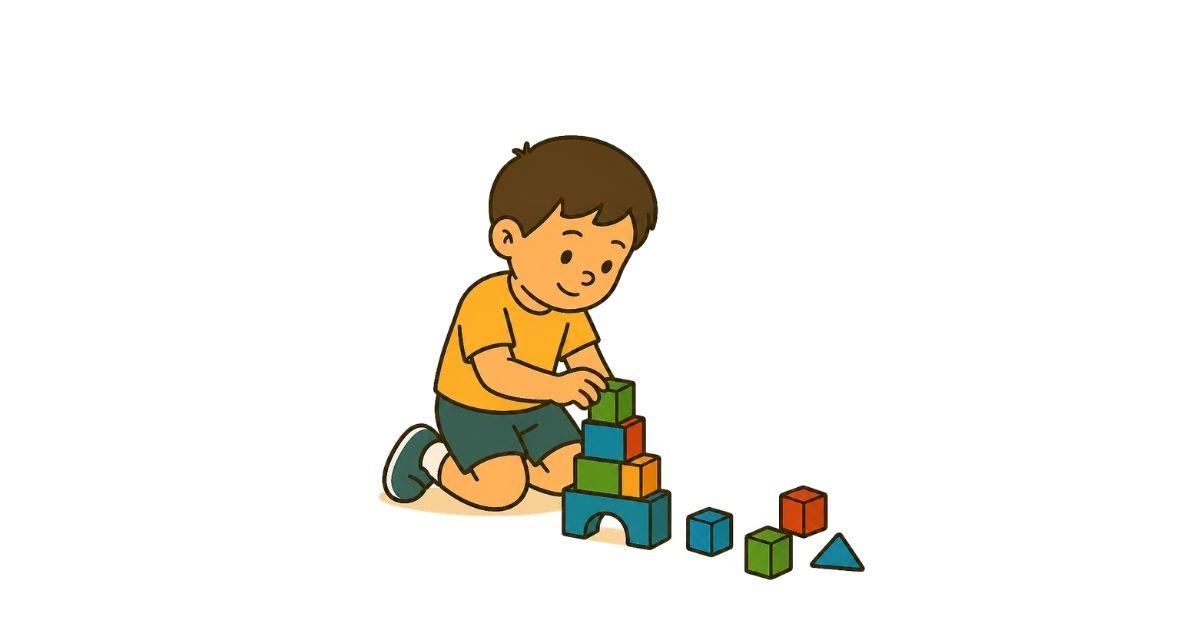
My three-year-old loves his magnetic tiles. He builds hotels, a parking area, an office — and the striking thing is that he often ends up with designs none of us could have dreamed up, that he himself hadn’t set out to make. The shape arrives in the building of it. There is no plan he’s executing, no result he’s chasing. There is just the absorption, and the absorption makes the thing.
Watching him, I notice something I keep forgetting: this is how all of us were once. And it is, quietly, how I do my own best work. The handful of times I’ve been genuinely lost in something — not tracking how it would land, what it would earn, who would notice — are the times I’ve felt most creative and, strangely, most at ease. There is so much here to learn from him. And yet we tell ourselves we are the ones doing the teaching — and somewhere in all that teaching, we take the very thing from them that we ought to be relearning ourselves.
And so there is no neat technique at the end of this. That would betray the whole idea — the point is not to control your child more skillfully, but to notice when the controlling is being driven by your own fear rather than your child’s actual needs.
The most useful question a parent can carry is not how do I get my child to do this? It is quieter and more uncomfortable: whose anxiety is this serving? When you feel the pull to slide the homework closer, to add the incentive, to ask about the test for the third time — that pull is real information. Sometimes it points to something the child genuinely needs. Often it points to something you need: relief from the unbearable uncertainty of not being able to guarantee how their life turns out.
You can’t guarantee it. No amount of control ever could. That is the hard truth underneath the paradox, and also, strangely, the freeing one. The child who is allowed to own their reasons — who studies because it interests them, reads because they fell into a book, tries because failing is survivable — carries an engine that doesn’t switch off when you leave the room.
That engine was there at the start. Every child is born with it. The deepest work of parenting may not be building it at all. It may be the harder discipline of not putting it out.
Leave a Reply